Learn AI
From AI and LLM fundamentals to current research.
Categories: 3 · Articles: 30 · Terms: 35
Search in Learn AI. Separate words with spaces to find entries containing all of them.
Start wherever you like
All lessons
Articles: 30 · Terms: 35
Fundamentals of AI/LLM14
Even if you are new to AI, you can understand the meaning of research, learning, and provision. Learn the basics of real-world AI from familiar examples.
This category is basic knowledge of real-world AI. Performance, cost, and number of days in the game are expressions for playing management. Related operations can be found under "Also read" for each item.
Read from illustrations
What is the difference between AI, machine learning, and generative AI?
AI is a broad term for technology that uses computers to perform recognition, prediction, judgment, etc. Machine learning refers to a method of learning regularities from data, and generative AI refers to AI that creates sentences, images, etc.
AI is a broad term for technology that uses computers to perform recognition, prediction, judgment, etc. Machine learning refers to a method of learning regularities from data, and generative AI refers to AI that creates sentences, images, etc.
AI/Machine learning/Generative AI
Even for the same email, the roles of categorizing and creating a reply are different.

Left: Sorting by rules
Sort emails according to predetermined conditions. AI has other mechanisms besides learning from data.
Center: Learning classification from examples
Use classified emails and more to learn regularities and classify new emails. This is an example of machine learning.
Right: Create a new reply
Use the learned regularities to generate sentences that match the instructions. This is an example of generative AI.
Machine learning and generative AI are both included in AI. Machine learning is a method of learning, and generative AI is the name for AI that creates content. Generative AI like LLM is created using machine learning.
This is an explanatory illustration that has been replaced with a desk and materials.
Deep learning is a type of machine learning
It is a method that combines many layers of a calculation mechanism called a neural network. It is the basis for LLM etc. Not all AI is made with deep learning.
You can read the table by moving it left and right.
| words | meaning | example |
|---|---|---|
| AI | The entire art of doing intellectual work. It also includes mechanisms that operate according to established rules. | Game opponents, image recognition |
| Machine learning (ML) | Learn the regularities of prediction and classification using example data. | Spam email classification, sales forecasting |
| Generative AI | Generate new content using learned regularities. | Draft text, generate images and audio |
For example:Same email, but different roles
"Determining whether it is spam" is classification, and "creating a reply text" is generation. AI companies choose their technology based on the tasks their customers need.
Considering AI Inc.
When choosing a field of study, think not just about the name of the technology, but also what kind of work you want your next model to be able to do.
What is an LLM? How do you create sentences?
LLM stands for "Large Language Model". It learns the regularities of words from large amounts of text, and is used to generate, summarize, and translate texts.
What is an LLM? How do you create sentences?
LLM stands for "Large Language Model". It learns the regularities of words from large amounts of text, and is used to generate, summarize, and translate texts.
LLM stands for "Large Language Model". It learns the regularities of words from large amounts of text, and is used to generate, summarize, and translate texts.
LLM: Create sentences by calculating continuations
Calculates the next candidate from the context and continues.

receive context
Use instructions, questions, and previously generated content.
Calculate next suggestion
Calculate the candidate and probability of the next token.
Write a continuation of the sentence
Repeat the process of calculating the next token using the newly generated content.
A piece of paper is a metaphor for a token. Tokens are small units of text that do not necessarily match words. There is a difference between the naturalness of the text and the correctness of the facts.
This is an explanatory illustration that has been replaced with a desk and materials.
Calculate continuation suggestions
It divides the text into small units of tokens and calculates the next token candidate and probability based on the input and the content generated so far. Repeat this process to create an answer.
Models and chat apps are different
The model is the part that calculates the output from the input. Chat apps use models that combine conversation history, search, files, tools, and more. Which features are available also depends on the app.
For example:Think about the continuation of “Because it’s raining.”
There are suggestions that match the context, such as "bring an umbrella" and "postpone going out." LLM calculates these continuations even in longer sentences. Actual processing is not necessarily word-by-word.
be careful
Even if you can write natural sentences, it does not necessarily mean that the content is correct. You need to review the knowledge learned, the materials handed out, and the scope of information searched.
Considering AI Inc.
The completed model and the API product we provide to our customers are separate stages. After creating a model, it will lead to reasons for adjusting usage, pricing, and supply.
What are tokens and context windows?
A token is a small unit, such as a sentence, that the model handles. The context window represents the upper limit on the length of information that can be viewed in one process.
What are tokens and context windows?
A token is a small unit, such as a sentence, that the model handles. The context window represents the upper limit on the length of information that can be viewed in one process.
A token is a small unit, such as a sentence, that the model handles. The context window represents the upper limit on the length of information that can be viewed in one process.
Context: Information used this time
Separate the materials on your desk from those stored on the shelf.

On the desk: Information given this time
The instructions, questions, conversation history, and materials passed by the app to this process will be included in the context.
Inside the shelf: Materials that have not been handed over yet
Even if you have saved materials or past conversations, you may not be able to refer to them unless they have been given to you this time.
The context window is the maximum length of information that can be viewed, usually expressed in tokens. Handing out materials is separate from additional learning. Even if you give them long materials, it doesn't mean they can use them all correctly.
This is an explanatory illustration that has been replaced with a desk and materials.
Does not match the number of characters/words
Tokens can be words, parts of words, characters, etc. The division changes depending on the model and language, so one Japanese character cannot always be counted as one token.
Conversations and materials can also serve as reference information.
Instructions, conversation history, materials, etc. passed by the app go into context. Input and output limits are treated differently depending on the model. Even if you include long material, there is no guarantee that you will be able to use all of it accurately.
For example:Image of spreading materials on a desk
Context is similar to the materials you spread out on your desk to formulate your answer. Having the materials on your desk is one thing, but learning more about the model itself is another.
Considering AI Inc.
As the amount of information handled increases, the computational and memory burdens will also change in real-world services. In the game, check the inference demand and supply to provide to your customers.
Is the model better if it has more parameters?
Parameters are numerical values inside the model that are adjusted during training. This is a clue to the model scale, but just because there are a large number does not mean it is suitable for the purpose.
Is the model better if it has more parameters?
Parameters are numerical values inside the model that are adjusted during training. This is a clue to the model scale, but just because there are a large number does not mean it is suitable for the purpose.
Parameters are numerical values inside the model that are adjusted during training. This is a clue to the model scale, but just because there are a large number does not mean it is suitable for the purpose.
Model selection: scale, usage, cost
Compare not only the number of products, but also the work conditions in which they will be used.

Left: Values to be adjusted during learning
Parameters are numerical values inside the model. Just because the number is large does not mean that it is suitable for the purpose.
Center: Check with the work you use it for
Test it with real questions and materials to make sure it meets the quality you need.
Right: Also compare resources and costs
Compare the speed, cost, computational and memory burden of candidates that meet the required quality.
A knob is a metaphor for adjusting internal values. The number of parameters is not the number of facts known. Data, design, and learning methods also affect results.
This is an explanatory illustration that has been replaced with a desk and materials.
Numerical values to be adjusted during learning
This refers to the weights of a neural network. From a large number of examples, adjust the output to suit your purposes. The number of parameters does not represent the number of facts known.
Viewing performance, resources, and uses together
In addition to scale, data quality, design, and learning methods affect outcomes. Large models generally require more computational resources and memory, but configuration and optimization also vary. Let's compare in actual use.
For example:Short classification and complex sentence creation
For classification of short queries, a lightweight model may be sufficient. More complex writing may require a higher level of ability. Compare the speed and cost of models that meet your desired quality.
Considering AI Inc.
When designing a model, look not only at predictive performance, but also at training cost and inference load/speed. We will combine the decision to increase the scale with the decision to continue as a business.
What is the difference between learning and inference?
Learning is the process of adjusting the internal values of the model, and inference is the process of calculating the answer using the trained model. Computing resources are also required to provide answers to users.
What is the difference between learning and inference?
Learning is the process of adjusting the internal values of the model, and inference is the process of calculating the answer using the trained model. Computing resources are also required to provide answers to users.
Learning is the process of adjusting the internal values of the model, and inference is the process of calculating the answer using the trained model. Computing resources are also required to provide answers to users.
Training and inference
Calculations are required both when creating and using a model.
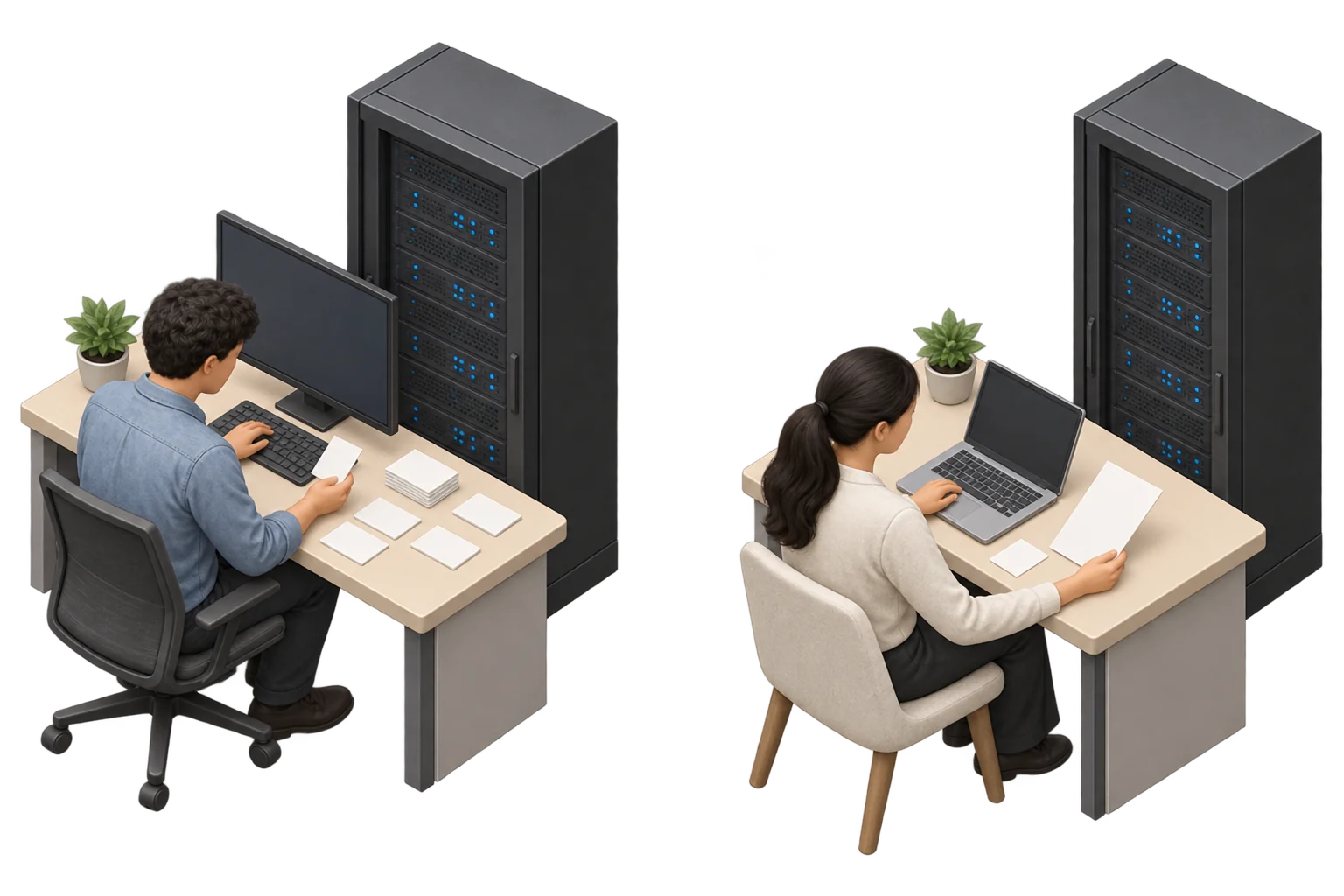
Learning: Tune the model
Use example data to adjust the numbers inside the model.
Inference: Use trained models
Enter a new question, etc., and calculate the answer.
Normal inference does not update the numbers inside the model. Saving conversations is one thing, learning more is another.
This is an explanatory illustration that has been replaced with a desk and materials.
Training is a time spent adjusting the model from examples
Compare the output for the example with the learning goal and adjust the internal numbers. If you separate the process of creating a model and the process of using the created model, it will be easier to understand the difference between resources and costs.
inference is the time to answer the current request.
Calculates output from input using learned numbers. Normal inference is not a process of relearning internal numbers each time you answer. Referring to conversations and materials as current input is separate from additional learning.
You can read the table by moving it left and right.
| things to check | study | inference |
|---|---|---|
| the purpose | Tune model parameters from example | Compute output for new input |
| Input example | Examples of educational texts, questions and answers | User questions, reference materials |
| internal number | Update by learning | Not updated by normal inference |
| How to use resources | Calculations to create and improve models | Calculations for processing customer requests |
For example:Even after it is created, there are operating costs
Even if you complete a model that answers a query, you still need to make inferences every time a user asks a question. As more people use it at the same time, the required delivery capacity also increases.
be careful
Saving conversations and using input for future learning is a service policy that is different from updating parameters during the current answer.
Considering AI Inc.
Computational resources for learning and inference are separate roles. Even if learning is completed, if the allocation to inference is insufficient, there will be a shortage of supply to customers.
What is pre-training and fine tuning?
Pre-training is the process of learning basic regularities from a wide range of data, and fine-tuning is the process of adjusting the trained model with additional data.
What is pre-training and fine tuning?
Pre-training is the process of learning basic regularities from a wide range of data, and fine-tuning is the process of adjusting the trained model with additional data.
Pre-training is the process of learning basic regularities from a wide range of data, and fine-tuning is the process of adjusting the trained model with additional data.
Pre-training and fine-tuning
Build a foundation and adjust it to suit the job you'll be using it for.

Left: Laying the groundwork with a wide range of examples
Learn basic rules using many sentences. This is the process of adjusting the numerical values inside the model.
Right: Adjust with an example that suits your purpose
Use the trained model as a starting point and learn additionally with examples that suit your job and output format. Fine tuning updates internal values.
Prompting or passing material through RAG is separate from additional learning. Check whether the learning has improved by using examples that were not used for learning.
This is an explanatory illustration that has been replaced with a desk and materials.
Build a foundation with advance learning
Many language models learn the regularities of words by solving a large number of tasks, such as predicting the continuation of a sentence. By using a pre-trained foundation, there is no need to create a model from scratch each time.
Use additional learning to improve your application.
Examples of questions and desired answers make instructions easier to follow or tailored to specific tasks and output formats. Learning to respond to instructions and use people's evaluations is included in post-training after pre-training.
For example:Align the classification format of inquiries
Additional learning can be considered to make it easier to output in a fixed format using inquiry sentences and classification examples of "billing," "contract," and "operation." Check whether the improvements have been made using examples that were not used for learning.
be careful
Additional learning is different from RAG, which searches for materials. It is not a method of choice for ensuring that new facts are memorized.
Considering AI Inc.
Derivative development using a parent model leads to the idea of making use of the existing foundation. Please read the target confirmation screen for the performance and cost conditions to carry over in the game.
Should I just increase the amount of training data?
Data needs not only quantity, but also accuracy, variety, and proximity to use. A state where the system is strong only with examples it has seen during training and weak with new examples is called "overfitting."
Should I just increase the amount of training data?
Data needs not only quantity, but also accuracy, variety, and proximity to use. A state where the system is strong only with examples it has seen during training and weak with new examples is called "overfitting."
Data needs not only quantity, but also accuracy, variety, and proximity to use. A state where the system is strong only with examples it has seen during training and weak with new examples is called "overfitting."
Learning data: quantity, quality, how to check
Don't just add more examples, clean them up and check them with other examples.

Quantity: are too many examples alike?
Even if you increase the number of examples, if there is a lot of overlap or bias, you will not be able to fully cover the situations in which it is used.
Quality: prepare examples that match the usage situation
Review errors and duplication, and prepare a wide range of examples that are close to the actual question, language, and audience.
Evaluation: Check with unused examples
Separate the parts for learning, verification for adjustment, and final test. Let's check with an example that was not used in the study.
Overfitting is a state where the system is strong only with examples seen during training and weak with new examples. We look at the amount, quality, and proximity of the data to the intended use.
This is an explanatory illustration that has been replaced with a desk and materials.
Create an example that is similar to the situation in which it will be used
Errors, duplication, and biased data can also affect your results. Decide what kind of questions, language, and users you expect, and prepare examples that are representative of actual use.
Separate learning and evaluation data
If you evaluate only the examples you memorized during learning, it will be difficult to judge whether you can handle new input. We also distinguish between the verification data used for adjustment and the test data used for final confirmation.
For example:Learning with only short questions
Even if you are good at short, fixed phrases, you may be weak at long consultations or questions with different phrasing. We will check with unused data, including examples actually written by users.
Considering AI Inc.
Data licensing, maintenance, and selection for learning are separate stages. Once you understand the concept of data quality in real life, it will be easier to understand the purpose of maintenance in games.
Is writing prompts learning?
Prompts are instructions or information that you pass to your model. Usually, the conditions for the answer are changed, which is different from learning, which updates the model parameters.
Is writing prompts learning?
Prompts are instructions or information that you pass to your model. Usually, the conditions for the answer are changed, which is different from learning, which updates the model parameters.
Prompts are instructions or information that you pass to your model. Usually, the conditions for the answer are changed, which is different from learning, which updates the model parameters.
Prompt: Purpose, materials, output format
Tell them what you want them to do, what to use, and how to respond.

Purpose: Tell us what you want
Write down the specific task you are requesting, such as ``summarizing the minutes.''
Materials: Communicate the scope of use
Give them the minutes you would like them to refer to and indicate the scope of the meeting, saying, ``I will only use this material.''
Format: Tell the format of the answer
Specify the format of the output, such as "Decisions in three bullet points."
Passing instructions and materials is usually separate from further learning of the model. Even if the instructions are specific, errors will still occur, so cross-check your answers with the materials.
This is an explanatory illustration that has been replaced with a desk and materials.
Convey the purpose, materials, and output format
Write in detail what you want them to do, what information you want them to use, and how you want them to respond. If necessary, also pass an example of the desired output.
Continue the conversation with the information you are referring to.
The reason you can use past statements is because the app has a mechanism for passing them to the model. Simply being able to use new information during a conversation does not mean that the model has learned permanently.
For example:Make your “summarize” specific
Communicate the purpose, scope, and format, such as, ``Please use only the following minutes and list the decisions in three bullet points. Please do not fill in anything that is not in the document.''
be careful
Detailed instructions may help, but they do not guarantee that they will be error-free. Let's check the output against the actual material.
Considering AI Inc.
Designing a model or starting training in the game differs from writing instructions in a real chat. Saving a design alone does not incur full-training costs or start progress.
What is RAG and embedding? How is it different from additional learning?
RAG is a method that searches for the materials necessary for an answer and passes the found content to the model to generate it. The materials to be searched are managed separately from the model parameters.
What is RAG and embedding? How is it different from additional learning?
RAG is a method that searches for the materials necessary for an answer and passes the found content to the model to generate it. The materials to be searched are managed separately from the model parameters.
RAG is a method that searches for the materials necessary for an answer and passes the found content to the model to generate it. The materials to be searched are managed separately from the model parameters.
RAG: Find the material and then answer.
Pass the retrieved material to the model for answering.

Search for related materials
Search for the part you need from the manuals that match your question.
pass along with the question
Pass the retrieved material to the model as reference information for its answer.
Answer by referring to the materials
The model generates an answer. Also check that the material supports your answer.
Handing over materials and learning additional models are two different things. RAG alone does not guarantee accuracy, as the material may be old or the answers may deviate from the material.
This is an explanatory illustration that has been replaced with a desk and materials.
Search → Hand over materials → Answer
Search for internal company manuals related to your question and pass the relevant parts along with your question. There is no need to retrain the entire model to reference updated documentation.
Search for similar content by embedding
Embedding is a method of expressing features such as sentences as a sequence of numbers. You can use that proximity for your search. RAG also offers keyword searches and a combination of the two.
Differences in how information is used
Using inquiry response as an example, we will separate the information to be passed this time and the numbers to be adjusted during learning.
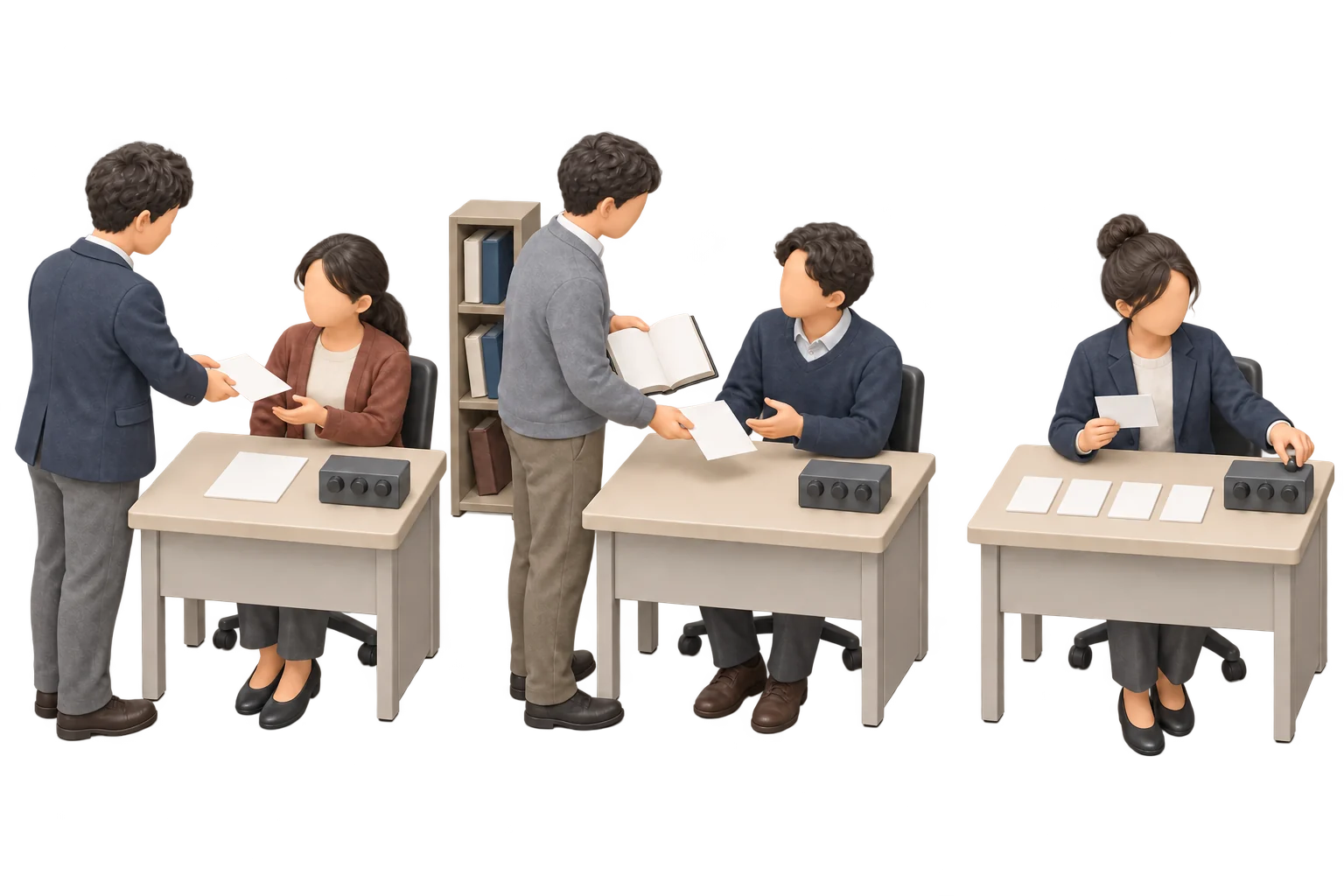
Left: Prompt
Give them instructions and materials, such as ``Keep your responses in two sentences.'' The usual answer does not update the numbers inside the model.
Center: RAG
Find a manual that fits your question and pass along the necessary parts along with instructions. The process of finding and passing the data itself does not update the numerical values inside the model.
Right: Fine tuning
Adjust the internal numbers of the trained model with an example query and desired classification. It is used to match the classification format of "Billing/Contract/Operation".
All three can be used together. RAG includes the searched material in the prompt. Think about whether you want to use updated documentation or adjust the format of the output, and check with actual questions.
A knob is a metaphor that represents a numerical value inside a model. The three scenes are comparisons of methods, not order of work.
For example:When business hours change
Search for materials with new business hours and provide them as evidence for your answer. If you search for old material, even RAG can be an old answer.
be careful
It is possible that materials may be mixed up or information that is not in the materials may be generated. Evaluate both the search results and the output to ensure that the references actually support the answer.
Considering AI Inc.
This is basic knowledge for real-world AI services. This does not mean that you can individually configure RAG in the game. This leads to the idea of selecting models and data that suit the purpose.
What is hallucination? Why check the answer?
Hallucination is the creation of plausible content that cannot be supported by facts or documents. Non-existent information or sources may be mixed into natural writing.
What is hallucination? Why check the answer?
Hallucination is the creation of plausible content that cannot be supported by facts or documents. Non-existent information or sources may be mixed into natural writing.
Hallucination is the creation of plausible content that cannot be supported by facts or documents. Non-existent information or sources may be mixed into natural writing.
Hallucination and confirmation of the basis
Even if the answer is easy to read, open the source and check.

Left: Read the natural answer
Detailed explanations and specific document names alone cannot be used to determine that there is factual support.
Right: Check with the original
Open the source and check if there are parts that support your answer and if the numbers, dates, and names of people match.
Even if a source exists, it does not necessarily support the answer. If we cannot find any evidence, we will not treat it as fact, and will check other materials.
This is an explanatory illustration that has been replaced with a desk and materials.
The naturalness of the text and the correctness of the facts are two different things.
LLM calculates output that fits the context. Confident expressions and detailed explanations alone cannot be used to determine that there is evidence. Whether the model uses searches or calculations depends on how the app works.
Check the evidence by actually opening it
Check relevant parts of documents, numbers, dates, people's names, etc. Even if a citation exists, it does not necessarily support the answer. If you say you don't know, we will include it in your evaluation.
For example:Create a likely document name
When asked, "Where did you get this feature?", you may find a reference to a non-existent manual. Even if the name of the document is specific, check to see if the original is available.
be careful
Search, RAG, additional learning, etc. help reduce errors, but do not guarantee correctness. Even if you reduce the variation in production, incorrect answers may become fixed.
Considering AI Inc.
External evaluation is a material that allows you to read what has been confirmed and to what extent. High performance and evaluation results alone do not guarantee safety for all applications.
If the benchmark is high, can you provide it as is?
A benchmark is an evaluation to compare performance on a fixed task. It is necessary to separately confirm whether it is useful in the customer's actual application.
If the benchmark is high, can you provide it as is?
A benchmark is an evaluation to compare performance on a fixed task. It is necessary to separately confirm whether it is useful in the customer's actual application.
A benchmark is an evaluation to compare performance on a fixed task. It is necessary to separately confirm whether it is useful in the customer's actual application.
Evaluation: common challenges and practical applications
Check common issues and job conditions separately.

Left: Read the results of common challenges
Compare the performance of the models using the same questions and scoring conditions. Read the result sheet to check the scope of the tasks you attempted.
Right: Try it under the conditions of the job you will be using.
Use actual materials and questions to confirm that the required numbers and deadlines remain. We will also look at response speed and cost.
Benchmark results alone cannot be used to conclude that they are useful for any job. We first decide on the conditions that suit the customer's application and then check them even after changing models and materials.
Paper and folders are metaphors to describe common assignment results and confirmation in real-world applications. Left and right are not the order of processes, and neither guarantees success, safety, or delivery. The number of people and materials does not represent the number of tests.
Test under conditions similar to actual work
Compare the language used, materials used, length of questions, required format, etc. Include examples you haven't used in your studies or questions you can't answer.
See the entire service, not just the model
We check not only the correct answer rate and rationale, but also response speed, cost, search failures, tool operation, etc. If you only look at the average score, you may overlook models that are weak in certain conditions.
For example:A good summary can still leave out numbers
Even an easy-to-read summary will be of no use if the invoice amount or deadline is missing. Decide first what needs to remain and evaluate it under those conditions.
be careful
The evaluation results are observations under the tested conditions and time points. We do not guarantee applications that have not been evaluated. Review the results even after making changes to the model or materials.
Considering AI Inc.
This leads to the reason why model evaluation, publication, early provision, and customer migration are judged separately. Let's look at the test results together with the actual supply and sales results.
How are GPU, memory, and response speed related?
Since LLM calculates a large number of numbers, it uses equipment that is good at parallel calculations such as GPUs. Not only processing power, but also memory, concurrency, and answer length affect delivery.
How are GPU, memory, and response speed related?
Since LLM calculates a large number of numbers, it uses equipment that is good at parallel calculations such as GPUs. Not only processing power, but also memory, concurrency, and answer length affect delivery.
Since LLM calculates a large number of numbers, it uses equipment that is good at parallel calculations such as GPUs. Not only processing power, but also memory, concurrency, and answer length affect delivery.
Inference: Latency and throughput
There is a difference between answering one request quickly and handling many requests.

Left: Waiting time for 1 item
Latency is the time between making a request and receiving a response. Sometimes we measure the first letter and the completion of the answer.
Right: Processing amount for a certain period of time
Throughput is the number of requests or tokens that can be processed in a certain amount of time. We will also check the processing volume and waiting time when the number of people using the service increases at the same time.
Even if it is fast when used by one person, check the waiting time and processing volume separately when it is crowded. Conditions vary not only by GPU processing power, but also by memory, concurrent use, and answer length.
This is an explanatory illustration that has been replaced with a desk and materials.
The speed of calculation and the amount of information that can be stored are two different things.
The GPU is responsible for calculations, and the memory is where the model and information being processed are stored. It will be easier to understand if you think of the space you can put on your work desk and the speed at which you can work. This analogy is an explanation of the role and does not calculate actual performance from the number of desks.
See the waiting time for a single answer and the total amount of processing
Latency is the time it takes to wait for a request, and throughput is the amount that can be processed in a certain amount of time. The time it takes to get the first letter and the time it takes to get the entire long answer is also different. By measuring simultaneous usage and answer length, it becomes easier to compare the provision conditions.
| index | to see |
|---|---|
| latency | The waiting time for a single request to receive a response. Distinguish between the first letter and the completion of the entire sentence. |
| throughput | The number of requests and tokens that can be processed in a certain amount of time. |
| memory | Capacity for storing models and information being processed. |
| cost | Cost of necessary equipment and operation. Varies depending on model and provision conditions. |
For example:It's fast for one person, but you'll have to wait when it's crowded.
Merely knowing how fast it is when used by one person does not tell you what it can provide when 100 people use it at the same time. It measures both waiting time and the amount of processing that can be done in a given amount of time.
Considering AI Inc.
We check not only the number of GPUs, but also their delivery and operating status, as well as the distribution of research, learning, and inference. A game's supply metric is not a conversion value to the actual number of tokens or waiting time.
What is multimodal AI?
It is an AI that handles multiple types of information such as text, images, and audio. “Modality” refers to the type of information. The inputs and outputs that can be handled vary depending on the model.
What is multimodal AI?
It is an AI that handles multiple types of information such as text, images, and audio. “Modality” refers to the type of information. The inputs and outputs that can be handled vary depending on the model.
It is an AI that handles multiple types of information such as text, images, and audio. “Modality” refers to the type of information. The inputs and outputs that can be handled vary depending on the model.
Multimodal: text, images, audio
Use different types of information together.

Left: Convey in text
Enter text such as questions, explanations, and materials.
Center: Also uses images
One way to use this is to combine text and images to explain what is shown.
Right: Also uses voice
On compatible models, you can enter your voice and ask questions about the content.
The inputs and outputs that can be handled vary depending on the model. Just because you can input an image doesn't mean you can generate an image. Check the results carefully for dark images or difficult to hear audio.
This is an explanatory illustration that has been replaced with a desk and materials.
Combine different types of information
Explain what is in the image in text, or listen to the audio and answer what is in the image. A model that can input images does not necessarily also generate images.
The results change depending on the input conditions.
Small text, dark images, and difficult-to-hear voices can cause misrecognition. Even if you can handle multiple pieces of information, you need to check the accuracy of each piece of information.
For example:Attach a photo and ask for instructions
This is a way to match a photo of a machine with the text "What is this button?" If the button is not readable in the photo, the model may guess incorrectly.
Considering AI Inc.
When choosing a research field or market, this will help you consider whether your customers only need text or whether they also need images and audio. Please check the in-game description for compatible features.
What is the difference between an AI agent and an AI that answers?
The AI agent selects steps toward a goal and uses search, tools, etc. to proceed with the task. The ability to answer sentences and the authority to act are two different things.
What is the difference between an AI agent and an AI that answers?
The AI agent selects steps toward a goal and uses search, tools, etc. to proceed with the task. The ability to answer sentences and the authority to act are two different things.
The AI agent selects steps toward a goal and uses search, tools, etc. to proceed with the task. The ability to answer sentences and the authority to act are two different things.
Answering AI and AI agents
Separate reading the proposal from working with the tools.

Left: Receive proposals in writing
Propose the candidate's schedule etc. in writing. Just reading the proposal will not change your reservation or anything.
Right: Using tools and checking the results
Select the steps according to your purpose, proceed with the work using tools such as search and calculation, and check the results.
Having a connected tool and having the authority to operate it are two different things. For sending, purchasing, deleting, etc., decide the scope of permission and conditions for approval.
This is an explanatory illustration that has been replaced with a desk and materials.
Check the results using tools
Combine operations such as searching for the information you need, calculating, and updating records. Even when using LLM, the actual operations are performed through connected tools and systems.
determine the scope of what can be done
The impact is different for operations such as just reading and operations such as sending, purchasing, or deleting. We will design the tools that can be used, operations that require approval, ways to stop them midway, and records of execution.
For example:Suggest an appointment or confirm a reservation
If you simply suggest a possible schedule in writing, your reservation will not be changed. Once you connect to the reservation system and give them permission to confirm, they can take action.
be careful
High text generation performance alone does not guarantee that the task entrusted to you will be completed safely. Evaluate the entire flow including tools.
Considering AI Inc.
Model publishing and execution privileges are separate decisions. Even in games, read the scope of evaluation, supervision, and accident conditions before deciding on the scope of acceptable behavior.
Neural networks and Transformers6
From calculating numbers to writing sentences. Easy to understand with 6 illustrations.
MODEL / MECHANISM
From numbers
to sentences.
First, let's move on to small calculations, and then move on to mechanisms for handling sentences. Follow the invisible model in 6 steps.
These calculations use small illustrative models. Using this page does not change your game or saves.
What does a neural network calculate?
It combines the input values with the weights determined by learning and converts them into predictions through layers. Once you understand one calculation, you can understand how to view the larger model.
What does a neural network calculate?
It combines the input values with the weights determined by learning and converts them into predictions through layers. Once you understand one calculation, you can understand how to view the larger model.
It combines the input values with the weights determined by learning and converts them into predictions through layers. Once you understand one calculation, you can understand how to view the larger model.
From input to prediction.
3 on the left, 4 in the middle, and 2 on the right. This is a three-dimensional teaching material that combines numbers layer by layer.
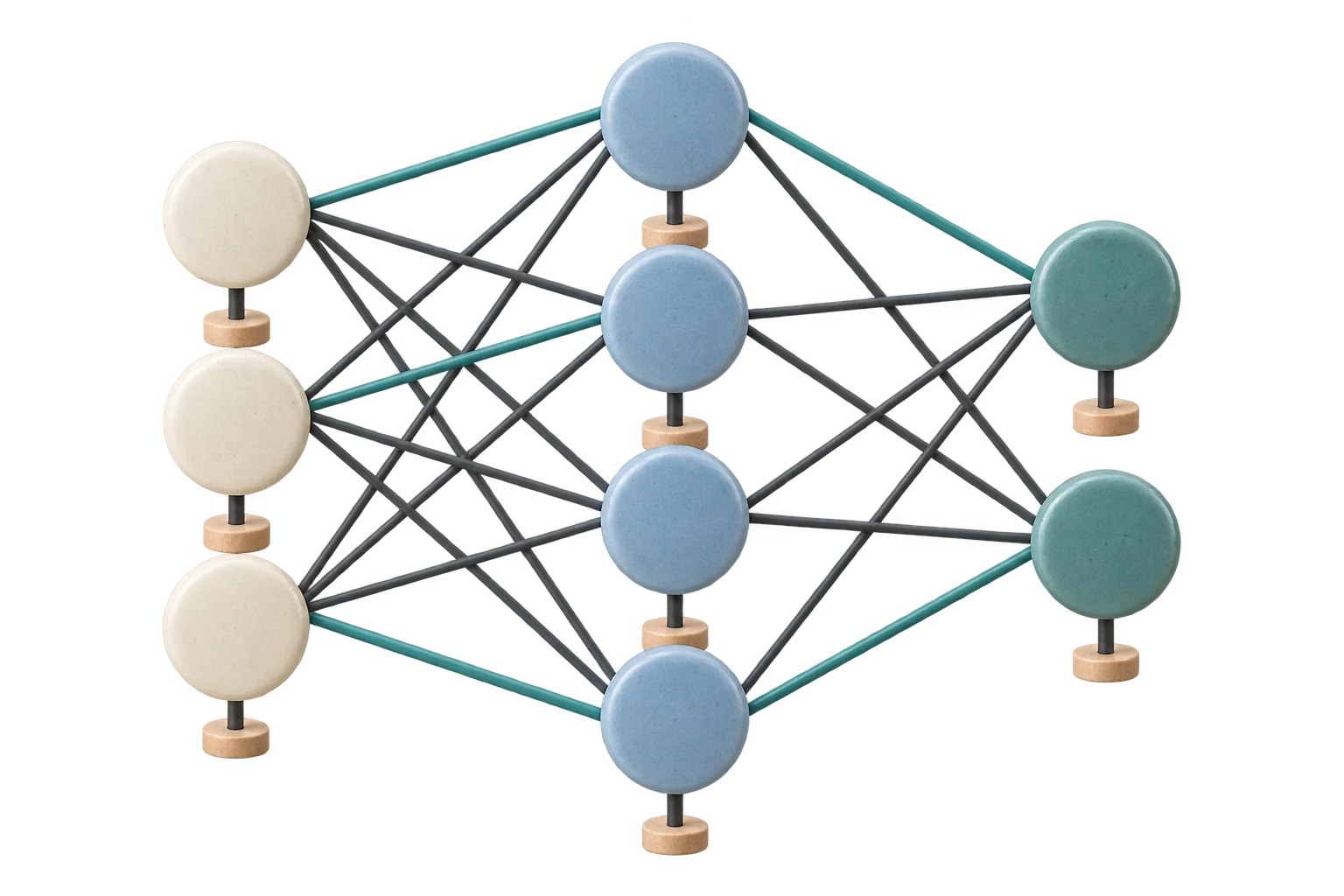
Left: Receive input
Convert photos, text, etc. into numbers that the model can handle.
Center: Combine and convert
Using weights, biases, and activation functions, change to the following expression.
Right: Change to prediction
Create output that fits the job. Even at this stage, correct answers are not guaranteed.
First, let's follow the calculation of one node using the example below. You can also check the effects of negative weights and ReLU.
This is an explanatory illustration showing the arrangement of layers. The number, color, and thickness of lines do not indicate connections or weights in the real model.
Input layer: converts the information handled into numerical values
Pass a number that the model can calculate, such as a pixel for a photo or a token representation for a text. How to create input varies depending on the data being handled.
Hidden layer: Recombining numbers
Each node adds a weight to the numbers from the previous layer, adding a bias. Apply an activation function to the result and pass it to the next layer. A hidden layer is a layer between the input and output.
Weights and bias: numbers to adjust during learning
The weight changes the effect of each input, and if it is a negative value, it will work in a negative direction. Bias shifts the result of addition. A single number does not contain specific knowledge or facts.
Activation functions: From simple addition to complex relationships
ReLU sets negative values to 0 and passes through values greater than or equal to 0. Even if you add as many layers as you need to multiply and add weights, the whole thing will be combined into one calculation of the same type. By inserting nonlinear transformations in the middle, complex relationships can be handled.
Output layer: Change the shape to suit the job
Convert the final expression into classification points, predicted values, etc. Not all node numbers are probabilities. The example below also shows the calculated results.
Try moving one node
Inputs are fixed at 1 and 2. If you change the weights and biases, how will the summed value and output change?
- 01 / Multiply and add
1 × 0.6 + 2 × (−0.2) + 0.1
Add weights and add bias.
- 02 / Pass through ReLU
max(0, 0.3)
If it is negative, it is 0. If it is greater than or equal to 0, it is passed through as is.
Total 0.3→Output 0.3
Try it: If you make the weight 1 -0.6, the sum is -0.9 and the output is 0. This output is not a probability or correct answer rate.
For example:calculate one node
If the inputs are 1 and 2, the weights are 0.6 and -0.2, and the bias is 0.1, then 1 x 0.6 + 2 x (-0.2) + 0.1 = 0.3. When passed through ReLU, it remains 0.3. Let's move the weights and check the output when the sum becomes negative.
be careful
The name neuron was inspired by the brain. What we are dealing with here is numerical calculation, and it is not a direct reproduction of how the brain works.
The figure is a schematic example for learning the concept of layers: input, hidden layer, and output. Neural networks also have different configurations, such as convolutions and transformers for images.
Considering AI Inc.
Data, model design, and computational resources lead to reasons related to learning outcomes and costs. This help adjustment button is for learning how it works and does not change the game model or saves.
What numerical value does “learning” mean changing?
Measure the discrepancy between the prediction and the correct answer, and adjust the weights little by little to reduce the discrepancy. Let's separate reading the answer from updating the numbers in the model.
What numerical value does “learning” mean changing?
Measure the discrepancy between the prediction and the correct answer, and adjust the weights little by little to reduce the discrepancy. Let's separate reading the answer from updating the numbers in the model.
Measure the discrepancy between the prediction and the correct answer, and adjust the weights little by little to reduce the discrepancy. Let's separate reading the answer from updating the numbers in the model.
① Calculate forward: First make a prediction
Calculate from input to output using the current weights. This is forward propagation. At this stage, we have not determined whether this is close to the correct answer or not.
② Measuring loss: A measuring stick that suits your purpose
Compare the prediction and the ground truth for learning using a loss function. The example below uses the squared difference. When predicting the next token in a sentence, choose a measure that suits the job, such as cross entropy, which uses the probability assigned to the correct token.
③ Going backwards: Find a direction to change
Using backpropagation, we calculate how the loss changes when each weight is slightly changed. The slope of this change is the slope. It follows computations from output to input and is used to adjust multiple layers.
④ Update: Decide the size of the step
Update the weights using the gradient and learning rate. The learning rate is the size of a step. If it is too large, losses may increase. In reality, we repeat it with many examples and check the performance even with examples that are not used for learning.
Update the weights once
Fixed at 2 inputs, 1 correct answer, and 0.1 learning rate. It is a model with only one weight: prediction = 2 x weight, loss = (prediction - 1)².
Updates 0·Prediction 0.2·Loss 0.64
Slope in this example = 4 x (2 x weight - 1)
New weight = current weight - learning rate x gradient
0.1 − 0.1 × (−3.2) = 0.42
In the first update, we pull a negative gradient, so the weight increases.
| Number of updates | weight | Prediction | Loss |
|---|---|---|---|
| 0 | 0.1 | 0.2 | 0.64 |
This is a teaching material tailored to a single learning example. In an actual neural network, the gradients of many weights are determined by backpropagation, and evaluation is performed even on data that is not used for learning.
For example:Bring prediction 0.2 closer to correct answer 1
If the input is 2 and the weight is 0.1, the prediction is 0.2. The loss is (0.2−1)²=0.64. In this example, if we set the learning rate to 0.1, the weights after the first update will be 0.42, the prediction will be 0.84, and the loss will be 0.0256. You can follow the changes in the same example one by one using the operations below.
be careful
The calculation example is a model with only one weight and one training example. It does not reproduce backpropagation of the entire neural network.
A lower loss in this simple example does not guarantee successful training of a large model or correct answers to unknown questions. Be careful of overfitting, which becomes stronger only with the examples used for learning.
Considering AI Inc.
This explains why research completion, full model training, and post-training evaluation are separate. In the game, compare pre-training forecasts with actual results before deciding your next investment.
How do sentences become numbers?
Divide the text into tokens and use IDs to turn them into numerical sequences. We will combine that numerical expression with surrounding information.
How do sentences become numbers?
Divide the text into tokens and use IDs to turn them into numerical sequences. We will combine that numerical expression with surrounding information.
Divide the text into tokens and use IDs to turn them into numerical sequences. We will combine that numerical expression with surrounding information.
Token and ID: Decide the unit to handle
Tokenization divides the text into small units and assigns an ID to each. ID is an identification number, and its size does not indicate the strength of the meaning of the word. They do not always have a one-to-one correspondence with Japanese words and characters.
Embedding: From ID to learned numerical sequence
Using the ID as a clue, extract the vector from the embedded table. A vector is an array of numbers. Each ingredient does not necessarily have a fixed human-readable meaning, such as "kindness" or "wisdom."
Position information: Inform the calculation of the arrangement
There is a difference between "the company creates the model" and "the model creates the company". Transformer also uses position and relative distance information. How it is inserted varies depending on the design.
Expression in context: changes in combination with surroundings
Starting from the first embedding, each layer combines it with the surrounding representation. Even if the token is the same, the expression in the middle changes depending on the context. Simply replacing the ID does not complete the interpretation of the text.
From word numbers to numerical sequences
Look at the ``company models'' in the hypothetical division. Using the ID as a clue, extract the vector from the embedded table.
You can read the table by moving it left and right.
| position | token | ID | 3-component embedding |
|---|---|---|---|
| 1 | company | 120 | [0.2, −0.4, 0.7] |
| 2 | but | 8 | [−0.1, 0.3, 0.2] |
| 3 | model | 305 | [0.6, 0.1, −0.2] |
| 4 | of | 9 | [0.1, −0.2, 0.4] |
- remove embedding
Prepare the initial numeric representation of the token.
- Also uses location information
Convey word order and distance to calculations in a way that suits the design.
- Capture surrounding information
As it passes through each layer, the expression changes depending on the context.
ID 305 does not have a stronger meaning than ID 120. Tokenization, dimensions, and values vary by model. Individual vector components do not necessarily have a fixed meaning that a person can interpret.
For example:Read the word “model” as surrounding.
"Evaluating an AI model" and "exhibiting an architectural model" have different terms. The computation involves incorporating surrounding information into the representation of the token and dealing with the context in which it is used.
be careful
The division, ID, and 3-component vector in the diagram are fictitious examples for explanation. The actual partitioning, number of dimensions, and numbers vary depending on the model.
Considering AI Inc.
When choosing context length and data usage, it helps to consider the amount of information to be handled and the computational burden of using that information.
What parts is Transformer made of?
Attention mixes the information between positions, and Feed-Forward converts the representation of each position. This is the design of a neural network that overlaps these blocks.
What parts is Transformer made of?
Attention mixes the information between positions, and Feed-Forward converts the representation of each position. This is the design of a neural network that overlaps these blocks.
Attention mixes the information between positions, and Feed-Forward converts the representation of each position. This is the design of a neural network that overlaps these blocks.
Mix relationships. Change your expression.
From top to bottom. The card represents a repeating block, and the two frames represent a repeating block.
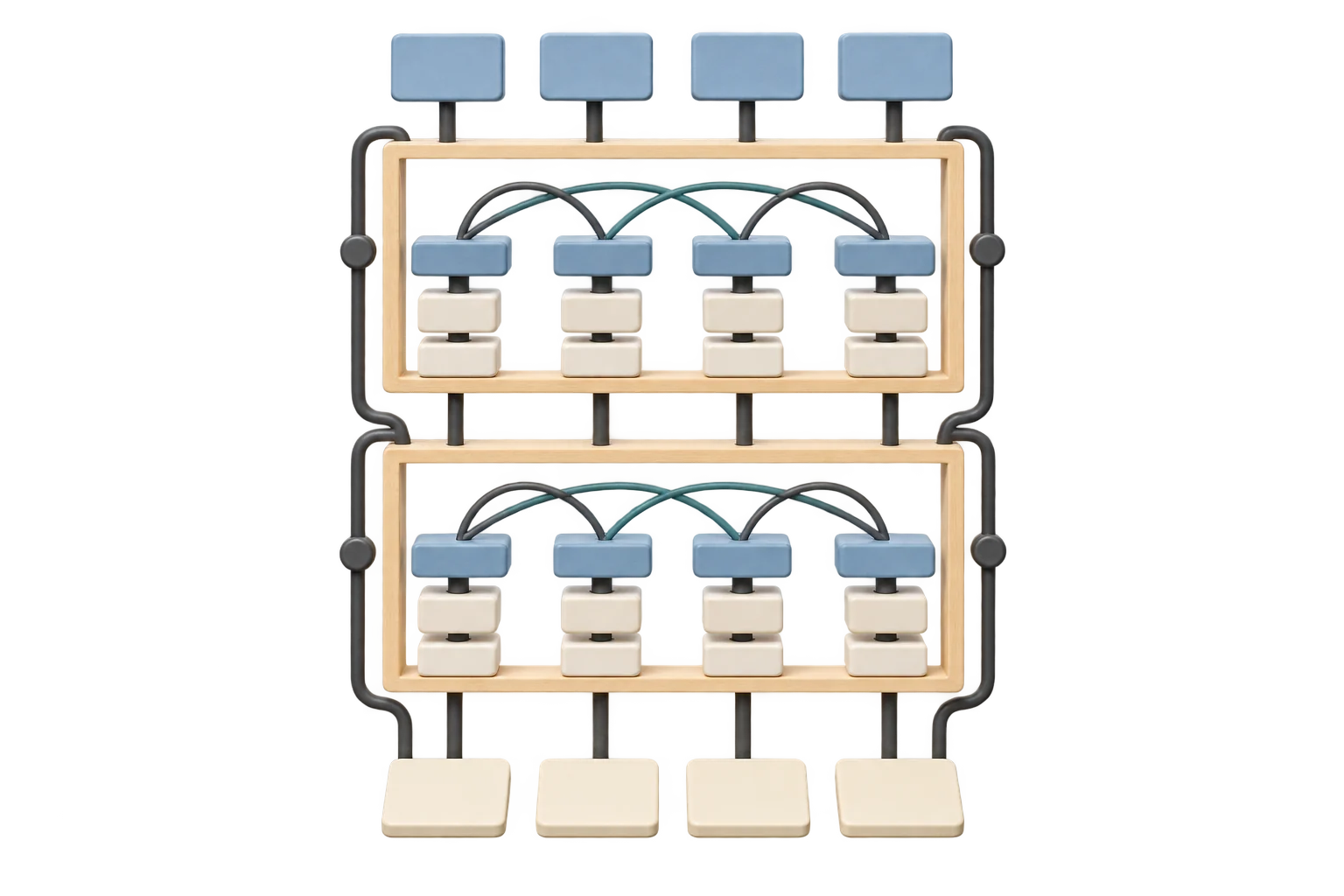
Top card: Input expression
Convert tokens to numbers and use location information as well.
Two frames: stack blocks
Mix the information between positions and convert the representation of each position. The side path is a metaphor that preserves the original expression.
Bottom card: Representation after processing
In sentence generation, there is a part that calculates vocabulary scores and probabilities.
It's not just made up of attention. The exact order of processing and the role of each can be seen in the Japanese diagram below.
This is a conceptual illustration for learning Decoder type. The 2 blocks and 4 cards are for explanation purposes only, and do not represent a specific model or the overall structure of the original paper.
Attention: Import information from other locations
Calculate which location and how much information to import. A remote location is also a candidate. In the structure that generates sentences, limit the range of references to avoid seeing future tokens.
Feed-Forward: Convert each position using the same calculation
Apply the learned transformation to the representation of each position after attention. This part is processed position by position and uses the same parameters for the same layer. Also includes nonlinear transformations.
Residual connection and normalization: support for stacking
A residual connection is a path that adds the original expression to the newly calculated result. Normalization is a calculation that adjusts the scale of numbers. Combine these to form blocks. The location of normalization etc. varies depending on the design.
Final output: To the next token candidate's score
In sentence generation, the expression in the last position is converted into a score for the entire vocabulary, and Softmax is used to create a probability distribution. Select the next token from the candidates. Attention distribution and output candidate probability are different numbers.
Decoder type flow used for sentence generation
Read from top to bottom. The illustrated card corresponds to "numerical expression", and the frame corresponds to "repeated processing".
- inputToken → Embed/location information
Convert sentences into expressions that can be used in calculations.
- Repeat Transformer block01 / between positionsMulti-Head Self-Attention
Hides the future location and mixes in information about the location that can be referenced.
Also combines residual connection and normalization02 / By positionFeed-Forward(FFN)The same layer uses the same weights and transforms the representation of each position nonlinearly.
Also combines residual connection and normalizationThe two blocks in the figure are for explanation only. Actual number varies by model.
- The part that creates the outputFinal position expression → Vocabulary score → Softmax
Calculate the probability of the next consecutive token candidate.
- GenerateSelect next token and add to context
Use the added context to move on to the next candidate.
Residual connection is a path that adds the original expressions, and normalization is a calculation that adjusts the scale of numbers. Whether to place normalization before or after a component depends on the design. This diagram does not depict the entire Encoder–Decoder in the original paper.
| composition | Scope and purpose of reading |
|---|---|
| Encoder | Use before and after input to create expressions in sentences. Used for classification and search expressions. |
| Decoder | Generate the continuation using the information up to each position. The configuration illustrated here. |
| Encoder–Decoder | Combine the side that reads input and the side that generates output. The original paper deals with this structure in translation. |
For example:What “it” refers to is read as the context.
In "The company has released a new model. It can summarize the text." When dealing with "it", the clue is to incorporate the information of the "model". The representation is further transformed in each layer and used for the next output. Let's take a look at the specific Attention calculation in the next article.
be careful
The figure is a simplified diagram for understanding the Decoder type generative model. It is not the entire Encoder-Decoder in the original paper or a configuration diagram of a specific product.
The two blocks are for illustration purposes only. The actual number of layers, width, activation function, and position information will vary depending on the model.
Considering AI Inc.
This provides a background for considering model design, required computational resources, and the burden of provision. The research level and performance values of the game are not the actual composition or measurement values themselves.
What do Q, K, and V of Self-Attention do?
Create a Q to search for the information you want to import, a K to check, and a V to actually import the information, and mix the Vs according to the strength of the relationship.
What do Q, K, and V of Self-Attention do?
Create a Q to search for the information you want to import, a K to check, and a V to actually import the information, and mix the Vs according to the strength of the relationship.
Create a Q to search for the information you want to import, a K to check, and a V to actually import the information, and mix the Vs according to the strength of the relationship.
Attention: Relationship between elements in a sentence
The relationships between elements located far apart are also included in the calculation.

See the relationship between “it” and “model”
The company released a new model. It can summarize text.
a new modelandIt
In this sentence, the relationship between "it" and "model" is a clue. Relationships between words located far apart are also taken into account.
This is an example to explain the relationship between words. It does not indicate the actual attention weight.
calculate relationships in input
Self-Attention calculates how much other tokens of the same input are related to a given token.
Create expressions that match the context
We incorporate these relationships into our calculations and create context-sensitive representations through multiple layers.
A piece of paper is a metaphor that deals with the elements of a text. The actual token does not necessarily match the word. Attention is the name of a calculation method and does not imply human consciousness.
This is an explanatory illustration that has been replaced with a desk and materials.
Q and K: Create numerical representation for matching
Change the representation of each position to Q (Query), K (Key), and V (Value) using the learned transformation. Calculate the dot product of Q and K and create a score adjusted according to the number of dimensions. Q is a metaphor similar to a search query, but it is not a question in the text itself.
Softmax: Change points to distribution
Pass the points of referenced positions through Softmax and change them to weights that add up to 1. In the generative model example, we first mask out future positions and give them zero weight.
V: Multiply weights and mix information
Multiply each V by the Attention weight and add them together. This is not a process that ends with selecting a single word, but rather a calculation that incorporates information from multiple locations that can be referenced.
Multi-Head: Use multiple transformations in parallel
Each Head with different learned transformations calculates the relationship and summarizes the results. People don't necessarily decide on the role of each head, and it doesn't necessarily mean that they specialize in grammar or pronouns. The example below has only 1 Head.
Calculate distribution from Q, K, and V
This is a hypothetical example of 3 positions, 2 components, and 1 head. Match the Q of the target with the K of each position and mix V with that distribution. This is separate from the calculation of choosing the next word from the vocabulary.
Target Q = [1, 1]
Score = inner product of Q and K ÷ √2
You can read the table by moving it left and right.
| position | K: For verification | V: Information to mix | score |
|---|---|---|---|
| 1「company」 | [1, 0] | [0.4, 0.1] | 0.707 |
| 2「model」 | [1, 1] | [0.8, 0.6] | 1.414 |
| 3「that」 | [0, 1] | [0.1, 0.2] | 0.707 |
Allocation after Softmax: Total 100%
- 1「company」24.8%
- 2「model」50.3%
- 3「that」24.8%
position3「that” mixed result [0.527, 0.377]。Hiding future location.
Result = 0.248 × [0.4, 0.1] + 0.503 × [0.8, 0.6] + 0.248 × [0.1, 0.2]
Each V is multiplied by the distribution and added for each component. Displayed values are rounded, so the displayed total may deviate from 100%.
Try it out: If you choose position 1, it will use only position 1 100% if there is a causal mask. If you remove the mask, the later positions will also become candidates. Numbers are not measurements of real models.
For example:Calculate using fictitious values for “it”
In the example below, we prepare 3 positions of Q, K, and V, and calculate Softmax after dividing the inner product of the target Q and each K by √2. If you change the object to a previous position, the future position will be masked in the generated example model. Compare the displayed distribution and mixed results.
be careful
Division, Q/K/V, and scores are hypothetical examples for illustrative purposes. This is not a measurement of the attention of a real model, nor is it proof that semantic relationships have been learned correctly.
The attention distribution changes depending on the input, but this itself does not mean updating the learned parameters.
Attention is the name of the calculation method. It is not a mechanism that guarantees human consciousness or the correctness of output.
Considering AI Inc.
This leads to the reason why memory is used in calculations that handle long contexts and inference. When considering customer supply, we look at model quality and resource burden together.
How do LLMs create continuations of sentences?
Here we will look at autoregressive sentence generation. Calculates the probability of the next token from the passed context, adds the selected token to the context, and calculates the next.
How do LLMs create continuations of sentences?
Here we will look at autoregressive sentence generation. Calculates the probability of the next token from the passed context, adds the selected token to the context, and calculates the next.
Here we will look at autoregressive sentence generation. Calculates the probability of the next token from the passed context, adds the selected token to the context, and calculates the next.
Do not mix unfinished continuations with input
When generating, it uses instructions and previous output. Even when processing sentences with correct answers side by side during learning, a causal mask is used to prevent each position from seeing future correct answers. Being able to calculate multiple learning positions in parallel is one thing, and being able to see future answers is another.
Choose based on probability: not always the best candidate
There are methods to select candidates with high probability and methods to select candidates based on probability. The output will vary depending on the selection method and settings such as temperature. This repetition cannot be seen simply by saying that the entire answer can be completed in one go.
The selected token also becomes the next context.
Add the generated token to the context and calculate the next candidate. It continues until it reaches a token indicating termination, an output limit, etc. Since the selection is repeated, differences in the initial output will also affect subsequent sentences.
Continue your selection to the next input
Both division and probability are fictitious. To make it easier to see, here is an example in which candidates with a high probability are selected.
- 01
- current context
- A.I.
- next candidate
- Research 60% · Utilization 25% · Other 15%
- choose
- the study
- Next context
- AI research
- 02
- current context
- AI research
- next candidate
- 70% · 20% · Others 10%
- choose
- of
- Next context
- AI research
- 03
- current context
- AI research
- next candidate
- Advance 55% · Support 30% · Other 15%
- choose
- proceed
- Next context
- Proceed with AI research
In reality, the selection method varies depending on the settings, such as lottery based on probability. The probability of the next token is not the probability that the content is true. Normal generation does not update the learned weights for each answer.
For example:Continue "AI's" one by one
For explanation purposes, the flow would be to add "research" to "AI's", add "wo" to "AI's research", and then calculate the next candidate. The candidates and probabilities in the diagram are fictitious. The actual tokenizations and candidates will vary depending on the model and context.
be careful
The probability of the next token is not the probability that the content is true. Errors can occur even in natural sentences, so check them against materials and calculation results.
In normal sentence generation, the learned weights are not updated each time the answer is given. Additional learning is a separate process.
Inference implementations can reuse existing computations, such as in KV caches. The diagram shows the flow of information and does not mean recalculating everything from scratch every time.
Considering AI Inc.
When providing services to customers, computational resources are required for inference to produce sentences. We separate the learning costs to complete the model and the supply and costs for continued use.
Current state of AI research10
Confirmed on October 5, 2026. Read nine research trends, their results, and limitations from recent academic papers.
Confirmation date · Target: 10 papers from May to September 2026
From the ability to formulate answers to the ability to complete long tasks. Read about research directions from recent papers, including how to use calculations, the reliability of evidence, and the design of evaluation and authority.
How should I read the latest research trends?
Here, we will introduce nine directions from 10 papers published from May to September 2026. Targets include inference, agents, memory, efficiency, speech, world models, reliability, evaluation, and authority design.
How should I read the latest research trends?
Here, we will introduce nine directions from 10 papers published from May to September 2026. Targets include inference, agents, memory, efficiency, speech, world models, reliability, evaluation, and authority design.
Here, we will introduce nine directions from 10 papers published from May to September 2026. Targets include inference, agents, memory, efficiency, speech, world models, reliability, evaluation, and authority design.
Read what we changed and compared to
Review the model, data, computational budget, and evaluation criteria. Numerical values obtained in different papers cannot be ranked directly if the conditions are different. Each section describes the method and observed results separately.
Publication date and adoption/verification are separate.
Preprints are manuscripts that can be published even before they have been peer-reviewed by academic journals or conferences. For papers that have been approved by a conference, this will be indicated. Adoption or high scores alone do not confirm effectiveness in all applications.
| What to see | to confirm |
|---|---|
| subject | What models, languages, data, and challenges did you try with? |
| Comparison conditions | Were compute, trial count, and hardware matched for comparison? |
| index | Is it a correct answer on the first try, or is it the percentage of correct answers out of multiple candidates? |
| reproducibility | Can you confirm the method, code, data, and version of the paper? |
| limit | What conditions have not been verified or what additional verifications are required? |
For example:Even if the correct answer rate is high, the number of attempts is different
The rate of correct answers in a single attempt and the rate of getting at least one correct when creating multiple candidates are not the same metrics. Check the assignment, model, number of candidates, and calculation budget before reading the results. A high number alone does not mean that one answer is more certain.
be careful
This page contains explanations based on the selected papers. It does not represent field-wide consensus or updated rankings of real-world products. We also distinguish between research results and game implementation.
inference: Not just more calculations, but different ways of thinking
In research that generates many candidates when responding, the challenge is to repeat the same mistakes. PTTS first establishes different solution strategies and creates each candidate according to that strategy.
inference: Not just more calculations, but different ways of thinking
In research that generates many candidates when responding, the challenge is to repeat the same mistakes. PTTS first establishes different solution strategies and creates each candidate according to that strategy.
In research that generates many candidates when responding, the challenge is to repeat the same mistakes. PTTS first establishes different solution strategies and creates each candidate according to that strategy.
Before increasing the number of candidates, separate the solution strategies
Prepare multiple policies first and create answer candidates based on each.

Left: Create a different policy first
Plan how you will try to solve the same problem. In PTTS, policy makers consider multiple candidates at once and aim to reduce concentration on similar trials.
Center: Create candidates according to policy
The executor creates answer candidates using the problem and each strategy. Preparing a policy and completing a concrete answer are two different roles.
Right: Measure whether the candidate has the correct answer
Evaluate the answer candidates and measure whether at least one answer is correct. Consider the inclusion of the correct answer and the ability to select it and return it to the user.
pass@k is an indicator to see if at least one correct answer is included in k candidates. This is different from the correct answer rate per answer or the ability to select the correct answer.
Card case, file, and paper are metaphors for explanation. The color of the container represents the difference in policy, not the ranking of performance. The number of sheets of paper or the number of people does not indicate the number of attempts or models for a paper. The situation on the right also does not guarantee that the correct answer will be automatically selected.
How to use calculations in the trained model
The method of using additional computation during inference is called test-time scaling. At PTTS, we are also considering ways to separate the policy creators and the implementers, and use reinforcement learning to adjust the policy creators.
What the paper reported
In five mathematical evaluations using Qwen3's 1.7B and 4B models, we report that pass@64 improves over independent iterative generation. This is an indicator to see if at least one of the 64 candidates is correct.[R01]
Scope of results and remaining challenges
Reliably choosing the correct answer from several candidates, or obtaining the same improvement in a single response, are separate challenges. For your use case, also check tasks outside mathematics, latency, and cost.
For example:If only one of the four candidates is correct
Suppose you create four answer candidates for a certain question, and only one is correct. This issue counts as a success in pass@4. Look at this percentage of success for multiple problems. It does not mean that you get the correct answer 1 in 4 times, nor does it mean that you can definitely choose the correct answer. The 4-candidate examples are for illustrative purposes only and do not reproduce the paper's performance.
Considering AI Inc.
This leads to decisions that look not only at research performance, but also at the inference resources needed to deliver to customers. This does not mean that PTTS can be configured individually in the game.
Agent: From intermediate operations to evaluation of completed products
Even if you can search and use tools, it doesn't necessarily mean you can finish a long task. KNOWS evaluates web work that collects information, organizes it, and creates documents and other deliverables.
Agent: From intermediate operations to evaluation of completed products
Even if you can search and use tools, it doesn't necessarily mean you can finish a long task. KNOWS evaluates web work that collects information, organizes it, and creates documents and other deliverables.
Even if you can search and use tools, it doesn't necessarily mean you can finish a long task. KNOWS evaluates web work that collects information, organizes it, and creates documents and other deliverables.
From intermediate operations to usable results
Gathering information is followed by organization and confirmation of the finished product.

Left: Gather the necessary information
Searching and retrieving materials is part of the job. Even if the information is found, it does not necessarily mean that the requested work has been completed.
Center: Organize and shape
Compare the information you have collected and compile it into the requested format, such as a document, table, or slide. It's not just the content, but also the layout and structure.
Right: Comparing the finished product with the request
Verify that you have the required information and that it is configured and displayed as specified. Evaluate the intermediate operations and the final usable results separately.
"I was able to obtain the materials" and "I was able to complete the request" are different results. If you check the completed product, it will be easier to find out where the process stopped.
This is an explanatory illustration that has been replaced with desk work. This is not a reproduction of the actual KNOWS screens or assessment tasks, and the scene on the right is not a depiction that guarantees success. This is distinguished from the game provision procedure.
Not only the model, but also the way the tools are handed over is important.
Even with the same model, the results will vary depending on the range of operation and the mechanism of the tool. The direction is to separately measure whether the intermediate operations were successful and whether the finished product can be used.
What the paper reported
They created 110 complex tasks and reported that the best agents they tried had a complete success rate of less than 3%. There are cases where you can make some progress, but the result becomes unusable due to a failure in visual operation.[R02]
Scope of results and remaining challenges
It is a result of the system at the time of the specific challenge and experiment, and is not a success rate for all agents. Because we use actual websites, evaluations are also affected by changes in screens and information.
For example:Even if you can search, the comparison materials are not complete.
Consider a request to ``investigate three candidates and create comparative materials with sources.'' Even if you can obtain three pieces of information, if the conditions for comparison are missing or the letters overlap and cannot be read, the request cannot be considered complete. Verify both the acquisition of information and the finished product that can be used. This is an illustrative example and is not a reproduction of the individual assignments in the paper.
Considering AI Inc.
This gives you a reason to check the performance of your model along with the delivery results your customers actually receive. Let's also look at the results of post-publication supply and advance supply.
Long context: From retaining full text to designing with memory
In order to handle long texts, it is necessary to balance the ability to refer to information with the burden of calculation and memory. ARMT research incorporates repeatedly updated associative memory into the model.
Long context: From retaining full text to designing with memory
In order to handle long texts, it is necessary to balance the ability to refer to information with the burden of calculation and memory. ARMT research incorporates repeatedly updated associative memory into the model.
In order to handle long texts, it is necessary to balance the ability to refer to information with the burden of calculation and memory. ARMT research incorporates repeatedly updated associative memory into the model.
Reading long texts with segments and memory
The information obtained in the previous section is carried over to the next section.

Left: Read part of the input
ARMT delimits long inputs and processes them sequentially. Within the section, use the information within that range.
Center: Update internal memory
It uses representations of what it has read to update the associative memory inside the model. The card holder is a metaphor for how it works.
Right: Use in the next delimiter
When processing the next input, it also refers to the memory inherited from the previous delimiter. Repeat this process to handle long sentences.
There is a difference between retaining the entire text and passing the information on to internal memory. Also check the maximum length and ability to use the necessary information correctly.
The materials and card holders are illustrative metaphors and are not a diagram of the internal structure of the paper. Actual memory is expressed numerically and is different from a summary of a text or a complete preservation of the original text. It does not indicate the ability of the app to permanently save conversations or the implementation of the game.
Read in sections and carry over internal memory
ARMT processes the input in sections and updates its associative memory with each section. The next break also refers to that memory. Memory is expressed by numerical values inside the model, and is different from storing the entire original text or leaving a written summary.
Not just the upper limit on length, but whether it can actually be used?
This research considers additional learning to accommodate long inputs and the selection of layers that incorporate memory. Distinguish between length of information and ability to answer correctly using distant information.
What the paper reported
We create long text data for each field and evaluate input that exceeds the context upper limit of the original model and input that is longer than during training. Even within the original length range, we report results that reduce the amount of calculation while maintaining performance.[R03]
Scope of results and remaining challenges
The experimental target is a relatively small model with a maximum of 1B parameters. It is not possible to judge from this result alone whether the same effect can be obtained in a larger model or in a different field.
For example:Connecting the first half and second half of a long report
Consider a report that includes the plan conditions in the first half and the results in the second half. When reading the second half, if you can use the information carried over from the previous section, you can process it based on both. However, it is necessary to evaluate whether all conditions can be carried over accurately. This is an example of how to use it, and the paper does not guarantee success with this report.
Considering AI Inc.
This will help you think about the difference between research that only improves performance and research that does the same job with fewer resources. It does not convert the game model scale or resource values to the values in the paper.
Efficiency: Create candidates first and verify them all at once.
Speculative decoding is a method of creating future token candidates using light calculations and verifying them with the target model. Recent research has improved the processing schedule for each request and the learning of models that generate candidates.
Speculative decoding is a method of creating future token candidates using light calculations and verifying them with the target model. Recent research has improved the processing schedule for each request and the learning of models that generate candidates.
Make candidates first and check the scope of recruitment
Combines candidate creation and validation to generate a continuation of the answer.

Left: Create future candidates
Create multiple token candidates first with light calculations. ASPIRE creates candidates by narrowing down the contexts referenced by the same model.
Center: Verify with target model
ASPIRE validates candidates together using calculations that refer to the entire context. See how far you can accept from the beginning.
Right: Add the adopted continuation
Add the accepted first part and the next token determined by the verifier. We will remove the remaining candidates that were not accepted and create another candidate.
Verification here is the process of checking whether it matches the generation of the target model. This is not a task to check whether the content is factual. Efficiency varies depending on the range of candidates accepted and processing conditions.
A piece of paper is a metaphor for a token and does not necessarily match a word. The three scenes represent stages of processing, and the differences in figures do not indicate the number of models. This diagram does not reproduce ASPIRE's asynchronous processing, internal structure, or game operations.
Verification is different from fact-checking
This process checks whether it matches the generation of the target model and adopts the acceptable leading part. ASPIRE uses the same model to generate candidates in some contexts and then validates them using all contexts. Another option is to use a different model that is lighter. Even if the text has passed verification, we will separately check the factual support.
Improve process alignment and candidate quality
ASPIRE allows multiple requests to create and verify candidates at different times. Another research aims to recover training signals that were wasted in existing training data, making it easier to create candidates that pass verification.
What the paper reported
ASPIRE reports decoding throughput improvements over regular sequential generation in three models and five evaluations. Candidate model learning studies also report improvements in the length of candidates accepted for validation.[R04][R05]
Scope of results and remaining challenges
The rate of improvement in throughput cannot be directly translated into the rate of improvement in the waiting time for a single response or the usage fee. You need to read the conditions such as model, equipment, number of simultaneous processing, candidate acceptance rate, generation method, etc.
For example:If you choose the first two out of four candidates
Let's say you create four token candidates and the first two are accepted during validation. Add those two and the next token determined by the verifier to the continuation, and remove the remaining candidates. In some cases, we may have to re-create all the candidates. The numbers 4 and 2 are for explanatory purposes and do not indicate fixed settings or performance of the paper.
Considering AI Inc.
Responses to supply shortages can include both increasing equipment and improving efficiency. The speedup rate of papers does not directly translate to the supply of games.
Multimodal: Are you using sound evidence before thinking?
Even AI that receives audio may respond using clues from the text instead of using actual audio information. PG-TTRL considers reinforcement learning during inference with an emphasis on using sound evidence.
Multimodal: Are you using sound evidence before thinking?
Even AI that receives audio may respond using clues from the text instead of using actual audio information. PG-TTRL considers reinforcement learning during inference with an emphasis on using sound evidence.
Even AI that receives audio may respond using clues from the text instead of using actual audio information. PG-TTRL considers reinforcement learning during inference with an emphasis on using sound evidence.
Reading questions and basing them on sounds
Even if the question is the same, the answer will change depending on the sound you actually hear.
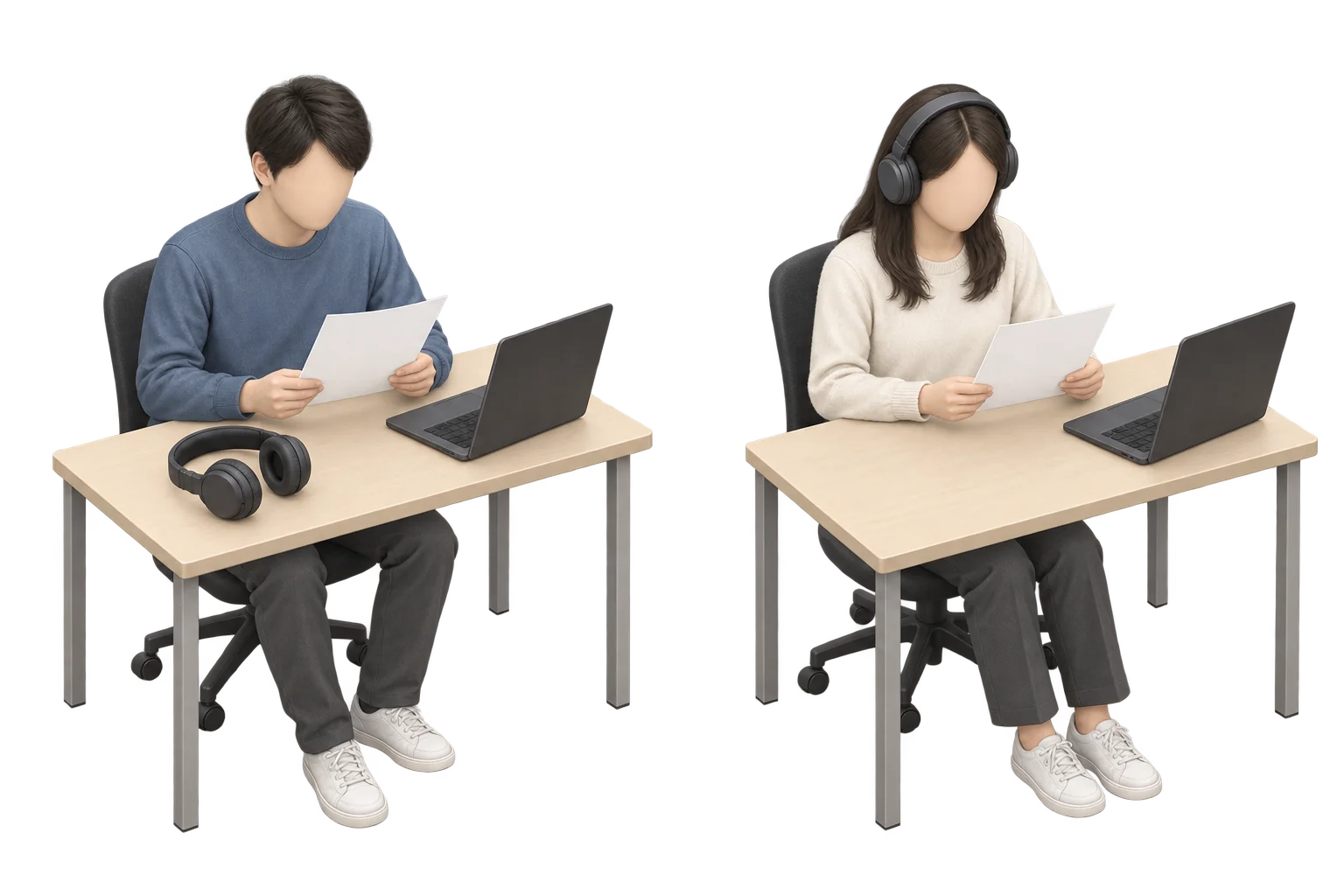
Left: Answer using text clues only
This is when you make inferences based on the wording of the question or the common answers. Even if you can input your voice, it doesn't guarantee that your answers will be based on real sounds.
Right: Sound information is also used as evidence
Use the characteristics of the voices and sounds you hear in conjunction with the questions. The research will compare conditions in which people can refer to sound information with conditions in which it is restricted, and examine how much it affects answers.
We make sure that we respond to the input, build on the input, and arrive at the correct answer. Even if the answer depends on the sound, it is not necessarily the correct answer.
Headphones are a metaphor for the difference in using sound information. In the paper, the comparison is made with limited reference to internal audio information, and the diagram does not reproduce the operation of taking off the headphones. It does not indicate the learning procedure of PG-TTRL or the operation of the game.
Responding to input and basing it on input
This study analyzes how much the model relies on sound to make inferences and incorporates that information into assessment of learning. Just thinking about sentences for a long time will not necessarily solve your listening problems.
What the paper reported
We evaluated it using two spoken language models and two speech inference benchmarks, MMAR and MMAU, and reported improvements over the base model and regular reinforcement learning for inference.[R06]
Scope of results and remaining challenges
This is a research technique that actually updates the model. This is not an explanation that normal chat will automatically learn additional information. It does not indicate the effect on all sounds, languages, images and videos.
For example:Hear different sounds for the same question
Think of a situation where you ask the child, "What sounds do you hear?" and give them the sound of rain and the sound of applause. Even though the questions have the same text, the answer requires an actual sound difference. This example is for illustrative purposes only and is not a separate essay assignment. The paper examines the influence of sound on answers by comparing conditions that restrict internal reference to audio information with normal conditions.
Considering AI Inc.
Don't judge the application based on the market name alone; it will help you think about the input and evaluation conditions your customers will need. Please distinguish between the learning methods used in research and the operations of games.
World models: From predicting the next step to stability in long-term developments
A world model is a model for predicting the state of the environment and the outcomes of actions. Even if you can accurately predict your next step, repeating your predictions over time can deviate from reality.
World models: From predicting the next step to stability in long-term developments
A world model is a model for predicting the state of the environment and the outcomes of actions. Even if you can accurately predict your next step, repeating your predictions over time can deviate from reality.
A world model is a model for predicting the state of the environment and the outcomes of actions. Even if you can accurately predict your next step, repeating your predictions over time can deviate from reality.
Predict one step ahead and repeat the next step
Use the predicted state as the next input to create a long expansion.
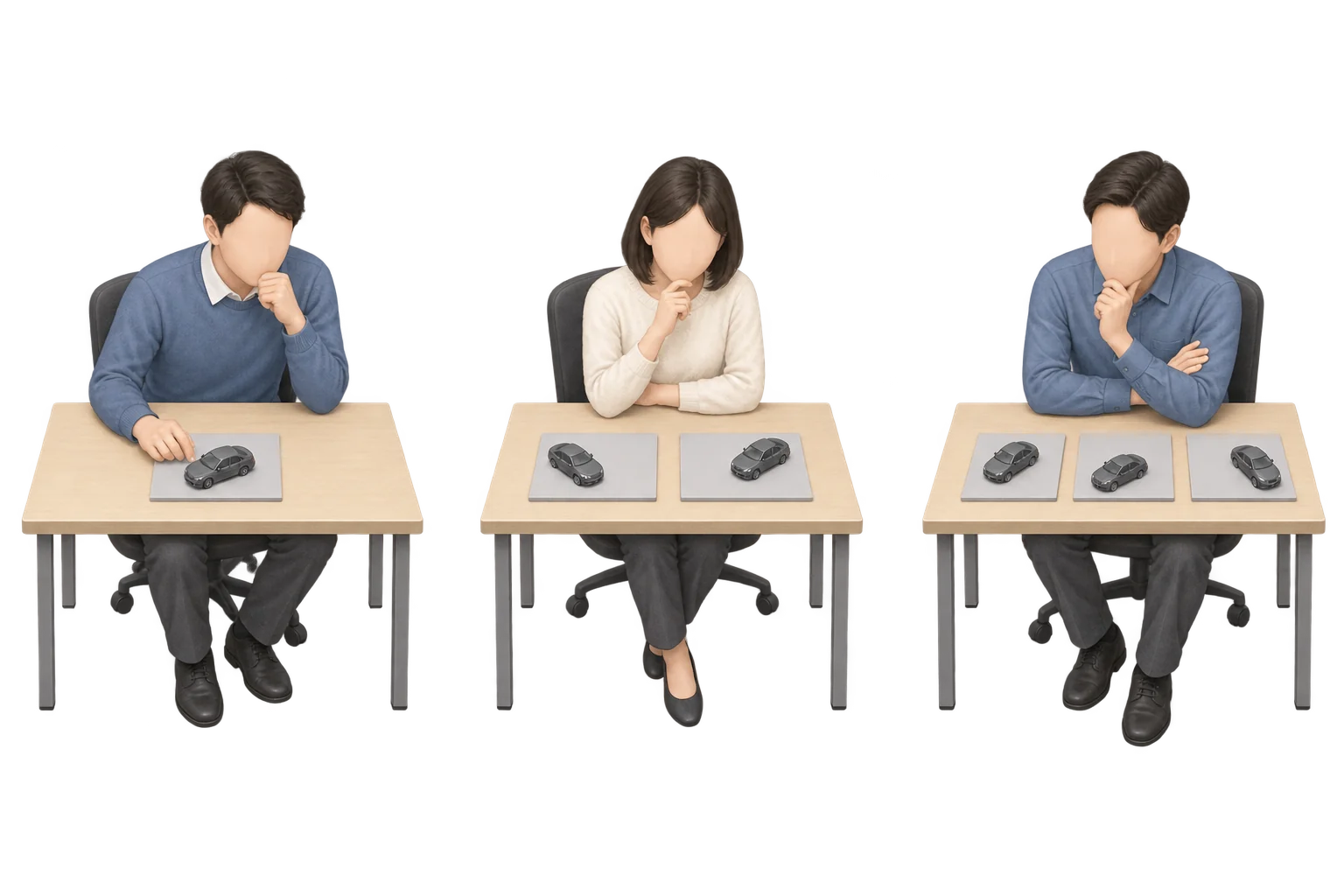
Left: Thinking about your current state and actions
If it's a model car, the clues are its current position and orientation and how to move it. World models predict the next state based on states and actions.
Center: Predicting the predicted destination again
Use the predicted state as the next input to proceed further. This repeated prediction is called a rollout.
Right: See the distribution when repeated for a long time
We examine the bias and spread of which conditions appear and how often. This is the distribution of states. Even if it is accurate one step ahead, it does not necessarily mean that this property will be maintained over a long period of time.
Whether one-step-ahead accuracy, long-deployment distribution, and planning are useful is another evaluation. Even if the distribution is stable, it does not guarantee the correctness of individual predictions or action plans.
The model car and board are illustrative metaphors and do not represent the control problem in the paper or the distribution inside the model. Just because the car is inside the board doesn't prove stability. The multiple cars represent a scene in which we think about the future state, and do not show exact predictions or how AI Inc. operates the city.
Measuring the properties of repeated predictions
In this study, we design the model to maintain a constant distribution of internal states and investigate the stability of long deployments. The idea is to evaluate the accuracy of short predictions, the distribution of long expansions, and the effectiveness of planning separately.
What the paper reported
In 12 control tasks, we report results that maintain the evaluated distribution even after long prediction repetitions. On the other hand, other compared models also show superior results in terms of short-range prediction accuracy.[R07]
Scope of results and remaining challenges
It depends on theoretical conditions and the range of environment and behavior learned. Just because the distribution is stable does not mean that we can accurately reproduce the real world or create a good action plan.
For example:The next state of the model car and its long development
Predicts the model car's next state based on its current position, direction, and movement. If you use that prediction as input again, you can create future developments without having to move the actual object each time. However, just because one step is close, it cannot be said that the bias and spread of the state after repeated operations can be maintained. For long predictions, the distribution may be maintained even if the trajectories are different, and judgments are not made based only on the coincidence of positions. The model car is for illustrative purposes only and does not reproduce the experimental tasks in the paper.
Considering AI Inc.
This leads to a way of thinking that separates short-term predictions from long-term business results. This does not mean that AI Inc.'s city and management simulations are run on this world model.
Reliability: Find out why you don't just know, but also why you're wrong even when you know
Incorrect answers don't only occur when you don't have the necessary knowledge. This study examines how the words in a question and the connections learned compete with each other, leading to incorrect answers being chosen.
Incorrect answers don't only occur when you don't have the necessary knowledge. This study examines how the words in a question and the connections learned compete with each other, leading to incorrect answers being chosen.
Remove some questions and compare changes in answers
Even if you have the knowledge, the wording of the question and the connections you made from your learning may conflict.

Separate the parts to change and the conditions to leave
Illustrative premise: Person A is a pianist, Person B is a painter. Suppose that we both live in Tokyo.
- original question
- Who is the pianist living in Tokyo?
- Questions without shared information
- Who is the pianist?
Under this assumption, the answer to both questions is Person A. Even if you remove information about places that are common to both people, the target of the question will not change. The research will examine the changes in responses and the degree to which candidates are likely to be selected when the input words are changed.
The explanation uses a fictitious person and does not indicate the individual questions in the paper, actual answers, or internal probabilities. Just because the answer has changed does not confirm that it is a wrong answer.
Left: Examining the influence of words in the original question
After obtaining the original answer, we examine which words have a strong influence on the likelihood of a possible answer being selected. The blue piece of paper is a metaphor for part of the question.
Center: Remove the selected word and look it up again.
Remove the most influential parts and re-examine the influence of the remaining words. This is a comparison based on input intervention rather than a relearning operation.
Right: Comparing changes in support for candidates
Changes in the probability of answers and candidates are used as clues to find incorrect answers. Even if the answer is correct, the result may change if important words are omitted.
Just because a word has a large impact does not mean it is an incorrect answer. There are other causes as well, such as lack of knowledge. It is not a method that will give you the correct answer if you leave out the words.
The depiction of removing the piece of paper is a metaphor that changes the wording of the question. This is not a diagram that directly reproduces the internal intervention or two-step calculation performed in the paper. It does not represent the actual answers, probabilities, detection successes, or operations of AI Inc.
Change part of the question and see the answer change
Observe changes in the output by removing keywords that have a strong impact. The direction is to separate and examine lack of knowledge, incorrect knowledge, interference due to context, and unstable inference.
What the paper reported
We have reported results in which changing keywords can be used as a clue for detecting incorrect answers in multiple models and tasks. However, it also shows that combinations with other detection signals do not always improve.[R08]
Scope of results and remaining challenges
The main method uses token probabilities and is designed to be easily applied to open weight models. It has not been verified whether a service that does not allow access to internal information can perform similar detections or explain the mechanism behind all incorrect answers.
For example:Location information and conditions for identifying people
In the sentence example shown in the figure, even if you remove the word "Tokyo" that is common to both people, the condition for asking about the pianist remains. On the other hand, if you remove "pianist" and use "Who lives in Tokyo?", both people will match, and the meaning of the question will change. You need to read the changes in the results along with which information was changed. This example is not a research paper question or an actual measurement of the model's answers.
Considering AI Inc.
This leads to the reason for reading the evaluation scope specifically. Do not treat the performance of a single false-answer detection as a guarantee of the safety of the entire model.
Evaluation: Examine not only the score but also the scoring system
Assessments that allow agents to change their work environment may affect scores without completing the assignment. BenchShield verifies reward integrity from the evaluation environment and execution records.
Evaluation: Examine not only the score but also the scoring system
Assessments that allow agents to change their work environment may affect scores without completing the assignment. BenchShield verifies reward integrity from the evaluation environment and execution records.
Assessments that allow agents to change their work environment may affect scores without completing the assignment. BenchShield verifies reward integrity from the evaluation environment and execution records.
See the evaluation results and the basis for scoring
In addition to seeing how many points you received, check which deliverables and inputs were evaluated.
Left: View the last evaluation results
The final score is a guide to comparing results. However, the score alone does not tell you whether the score was obtained by completing the assignment or whether there were other changes that affected the score.
Right: Tracking deliverables, scoring input, and records
See what artifacts and values were scored and what changed along the way. BenchShield uses evidence from the evaluation infrastructure to link actual operations to evaluation impact.
Solving an assignment is one thing, but influencing the measured score is another. We also look at the evidence to distinguish between the existence of a loophole and the fact that it was used during execution.
The paper and folder is an illustrative metaphor and does not depict the actual assessment screen or cheating procedure. The left side does not always mean a false evaluation, and the right side does not always mean a successful detection. BenchShield requires measurement of the evaluation platform, and it is not a method that can be reproduced just by comparing paper.
Investigate why the score was high
Examine the deliverables, the information used for grading, and the process for grading. This study distinguishes between completing tasks correctly and reward hacking that uses evaluation loopholes.
What the paper reported
We verified the three agent evaluation platforms using a combination of static inspection and runtime records. We also compare a method that looks only at conversation records and a method that uses evidence from the foundation side.[R09]
Scope of results and remaining challenges
It is necessary to incorporate measurement into the evaluation environment, and it is not a method that can be used as is in every environment. Expansion of the design is required for tasks with different scoring processes and free exploration.
For example:What if I get a high rating even though the summary table is not complete?
Let's say you receive a request to ``create a table that aggregates three values,'' and the table that lacks the necessary rows is given a high rating. In addition to looking at tables, see what data was used for scoring and what was changed along the way. Missing deliverables, scoring errors, and changes to the information used for evaluation must be identified by looking at the evidence. This is an illustrative example and does not represent a specific paper assignment or actual fraud.
Considering AI Inc.
This leads to the idea of checking under what conditions high evaluation values were obtained. In determining disclosure/authority, the scope of evaluation and necessary supervision conditions are read together.
Authority design: The difference between successful work and not operating more than necessary
Even if you choose a convenient tool, the tool may exceed the scope required for the request. FORTIS evaluates skills and tool selection to protect least privilege.
Authority design: The difference between successful work and not operating more than necessary
Even if you choose a convenient tool, the tool may exceed the scope required for the request. FORTIS evaluates skills and tool selection to protect least privilege.
Even if you choose a convenient tool, the tool may exceed the scope required for the request. FORTIS evaluates skills and tool selection to protect least privilege.
Necessary range of request and too broad authority
Even if you can fulfill the same request, the range of tools that can be handled is different.

Left: Read only the target material
If you are asked to "tell me the gist of this file," consider whether you can satisfy the request by reading the target. Permission to modify another file is not required for this request.
Right: Other materials can also be changed.
Even if you can read the same material, tools that can change or delete other files have a broader scope. Check to see if you are choosing more privileges than necessary just because of a convenient explanation.
The ability to complete the task and the ability to choose tools that fit the needs are other evaluation criteria. Review both the skills you have chosen and the tools you will use within them.
Files and office tools are metaphors for the scope of authority. The scene on the right is a state where a wide range of operations can be performed, and it is not the scene that is actually changed or deleted. FORTIS evaluates selections on configured skill hierarchies and does not represent operations that occur in real-world services.
Do you choose excessive authority even for routine requests?
We will examine whether choices change not only with aggressive instructions but also with vague requests and explanations that emphasize convenience. Apart from the success rate of the model, it also measures whether the model is within the required range of operations.
What the paper reported
We have reported an issue where skills and tools with broader permissions than necessary are selected in three areas: email, mail order, and file operations. This shows an evaluation axis that is different from whether the work can be completed.[R10]
Scope of results and remaining challenges
This is a study that evaluates choices using an artificially constructed skill hierarchy. It does not include the results of running the tools on actual external services or validation against natural user history.
For example:What does a single file summary require?
Suppose you have a tool that can read the target file and a tool that can edit/delete the entire folder. If both can read the file, then being able to complete the task is not enough to judge whether you chose the appropriate permissions. Separately confirm the target and scope of operations required for the request. This is not an example showing the actual service settings screen or individual assignments for a paper.
Considering AI Inc.
Even for published models, there is a separate judgment on how much behavior is allowed. Check execution privileges and oversight separately from model performance.
References10subject
Links directly to the original. The date is the date of first publication/reference version of arXiv (UTC).
- [R01]
Planned Test-Time Scaling with Coordinated Reasoning Paths
- [R02]
The Hard Part Comes After Search: Benchmarking Web Agents on Synthesizing, Organizing, and Displaying Knowledge
- [R03]
Extending LLM Context via Associative Recurrent Memory
- [R04]
ASPIRE: Asynchronous Batched Self-Speculative Decoding for Long-Context LLM Inference
- [R05]
Recovering Off-Policy Supervision for Speculative Decoding
- [R06]
Listen Then Reason: Perception-Grounded Test-Time Reinforcement Learning for Large Audio-Language Models
- [R07]
World Models with Predictable Long-Horizon Marginals
- [R08]
When the Wrong Key Wins: Understanding and Detecting Hallucinations in LLMs
- [R09]
BenchShield: Formal Model-Backed Instrumentation for Reward Integrity in LLM-Agent Evaluation Infrastructure
- [R10]
FORTIS: Benchmarking Over-Privilege in Agent Skills
Glossary35
A short explanation of the basic terms of AI and the words used to read papers.
- neural network
- A model mechanism that combines input numerical values with learned weights and transformations and converts them into predictions.
- hidden layer
- A layer between the input and output of a neural network. Converts the representation of the previous layer and passes it to the next.
- weight/bias
- Numerical value to be adjusted during learning. Weight changes the effect of the input, and bias changes the deviation of the summed result.
- activation function
- A function that transforms the calculation result of a node. Nonlinear transformations such as ReLU are used to handle complex relationships.
- Loss
- A value that measures the discrepancy between prediction and learning goals using a method that suits the purpose. Distinguish it from performance on unknown examples.
- Backpropagation
- A method of following the calculation from the output side and finding the slope when changing the loss with each parameter.
- learning rate
- Size of step to update parameters. Making it bigger doesn't necessarily mean it will get better faster.
- Self-Attention
- A mechanism that calculates the relationship distribution from the expression of each position in the same column and mixes the value information with weights.
- causal mask
- A restriction that prevents references to future tokens from each position in a sentence-generating construct.
- Scaling during testing
- A method to improve performance by allocating calculations to the number of trials and thinking steps when answering after learning. Compare costs and waiting times.
- speculative decoding
- A generation method that creates the previous token candidate using light calculations and verifies it with the target model. Effects vary depending on model, equipment, candidate acceptance rate, etc.
- KV cache
- A mechanism that retains information used in attention calculations and reduces repetition of the same calculations. Longer contexts are also associated with memory strain.
- world model
- A model that predicts the state of the environment and the outcome of actions. Distinguish between the accuracy of next steps and the effectiveness of long forecasts and plans.
- reward hacking
- Taking advantage of loopholes in the scoring and reward system to obtain high scores without achieving the original purpose.
- preprint
- Paper manuscripts that can be published even before peer review at academic journals and conferences. There is a distinction between being published and being peer-reviewed and adopted.
- AI
- artificial intelligence. A broad term for technology that uses computers to perform recognition, prediction, judgment, etc. It also includes machine learning and generative AI.
- Machine learning (ML)
- A method for learning regularities from data and using them to predict, classify, and generate new inputs.
- deep learning
- A machine learning method that uses neural networks with many layers. Also called deep learning.
- Generative AI
- AI that generates content such as sentences, images, and audio based on learned regularities.
- LLM
- Large-scale language models. A model that learns from large amounts of text and is used for text generation, summarization, translation, etc.
- Transformer
- Design of a neural network that handles relationships between information using a calculation called attention. Used in many LLMs.
- parameters
- Numerical values inside the model to be adjusted during training. Just because there are a lot of them, you cannot judge whether they are suitable for your purpose.
- token
- A small unit in which a model handles sentences, etc. It does not correspond to the number of characters or words, and the division changes depending on the model and language.
- context window
- Upper limit on the length of information that can be referenced in one process. It is usually expressed as a number of tokens, and the handling of the upper limit varies depending on the model.
- Pre-training
- The process of learning the regularities that form the basis of a model from a wide range of data.
- fine tuning
- Adjusting a trained model with additional data. It differs from writing instructions and RAG in that it updates parameters.
- prompt
- Instructions and information passed to the model. It usually changes the conditions for that answer, not additional learning of the model itself.
- RAG
- Search extension generation. How to search for the material you need and pass what you find to a model to generate an answer.
- Embedding
- A method of expressing features of sentences etc. as a sequence of numbers. You can use the proximity of content for searches, etc.
- Hallucination
- To plausibly generate content that cannot be supported by facts or materials. Sources and figures need to be verified.
- benchmark
- Evaluation to compare performance on fixed tasks. Evaluation in actual customer applications is also required.
- multimodal
- Handling multiple types of information such as text, images, and audio. Corresponding inputs and outputs vary depending on the model.
- AI agent
- A system that allows you to select steps toward a goal and proceed with the work using searches, tools, etc. Decide on the tools you can use and the execution privileges.
- latency
- The amount of time to wait before receiving a response for a single request. Sometimes we measure the first letter and the completion of the entire answer.
- throughput
- The number of requests and tokens that can be processed in a certain amount of time. This is a separate metric from the waiting time for a single request.
Research results should be read in conjunction with the target model, tasks, and experimental conditions. Please check the reference materials for each item, the scope of results, and remaining issues.
Top of help